
I was in Phnom Penh, the capital of Cambodia, for less than 24 hours when I visited the Tuol Sleng Genocide Museum. It was a sobering experience. It seemed to bring back significant trauma for me of living through the 2003 Iraq war – I was in university at that time – and poignantly my Cambodia trip was during the Gaza genocide. Although I generally look for cultural experiences, this was part of my city tour, and as it was a museum, I was curious. I did see art, but of an entirely different kind.
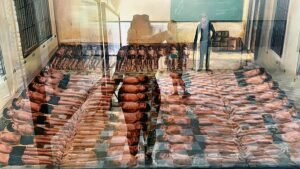
Walking through the building, which was once a school then prison/execution centre before it became a museum, I was unprepared for the raw emotion of seeing photos of the victims, the weapons used to torture them, the blood-stained floors and the obviously horrific conditions they had to endure during the last days of their lives at the hands of Khmer Rouge, typically in overcrowded cells without adequate food, water, or sanitation.
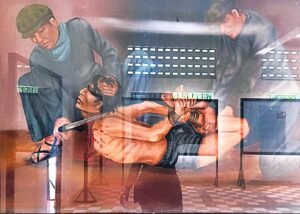
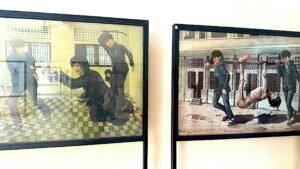
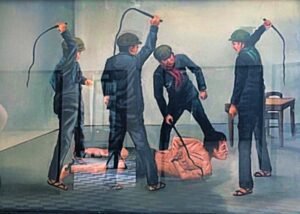
The museum displays thousands of photographs of the prisoners taken upon their arrival. It also displays paintings, which I wasn’t expecting, created by one of only 7 survivors out of an estimated 200,000 victims who passed through its doors. I met the artist at the museum where he was selling his memoir: “Bou Meng: A Survivor from Khmer Rouge Prison S-21,” an important testimony about the atrocities of the Khmer Rouge. I wanted to take a photo with him, but felt it was inappropriate at the time given the sombre mood.
Equally important is Bou Meng’s art, which played a crucial role in his survival during the Khmer Rouge regime, particularly during his imprisonment at Tuol Sleng. His talent as an artist not only saved his life but also left a lasting legacy, providing a poignant and personal perspective on the atrocities committed during that period.
Bou Meng’s skills as an artist saved his life. The prison authorities discovered his talent and assigned him to paint portraits of Pol Pot. They needed artists to create portraits of Pol Pot, the leader of the Khmer Rouge, and other propaganda materials. This work spared him from the immediate executions that befell most of the other prisoners.
Creating art under such extreme conditions was a harrowing experience. While his artistic skills saved his life, the context in which he worked was filled with fear, suffering, and loss.
I had studied the Khmer Rouge led by the notorious dictator Pol Pot at school. It was part of the reason I wanted to visit Cambodia. But the extent of the horrors didn’t really hit me till I visited that museum. Regrettably, it left me reeling for the entirety of the rest of the trip as I contemplated what this country had been through in the not-so-distant past.
The Khmer Rouge were a radical communist party who took control of Cambodia in April 1975. Their goal was to transform Cambodia into a classless agrarian society, which led to forced relocations, mass executions, and widespread starvation. The regime’s policies resulted in the deaths of an estimated 1.7 to 2 million people between 1975 and 1979, nearly a quarter of Cambodia’s population at the time, known as the Cambodian genocide.
During the genocide, the Tuol Sleng Genocide Museum was known as Security Prison 21 and became the main interrogation and extermination centre for the regime. Prisoners included political opponents, intellectuals, professionals, and even suspected traitors within the Khmer Rouge regime itself. Prisoners were subjected to horrific torture to extract confessions, often for crimes they did not commit, and in order to incriminate others. Often, their families were imprisoned there too.
Before the Khmer Rouge took over, Bou Meng was an artist, living a relatively peaceful life with his family in rural Camodia. In 1977, he and his wife were arrested by the Khmer Rouge. They were accused of being traitors—charges that were typically baseless and used to justify the regime’s actions. They were taken to S-21, where his wife was killed.
After the fall of the Khmer Rouge, Bou Meng continued to use his art as a means to process and express the trauma he endured. His art also serves an educational purpose. Through his paintings and drawings, he has helped illustrate the brutal reality of life under the Khmer Rouge, making the historical narrative more accessible and impactful for viewers.
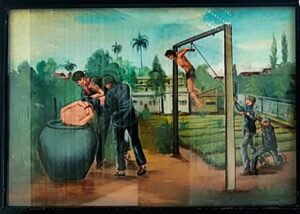
Bou Meng’s art is significant mainly for its historical and emotional depth. It embodies the pain and resilience of a survivor and offers a deeply personal perspective on a national tragedy. His works continue to educate and inform people about the Khmer Rouge era, providing a human face to the statistics and historical records. Through his work, he continues to contribute to the collective memory and understanding of the Khmer Rouge’s impact on Cambodia and its people.
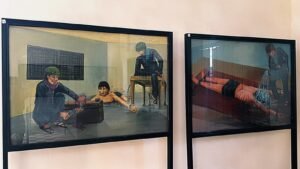
Visiting Tuol Sleng is a deeply emotional experience. The stark and haunting exhibits leave a lasting impression on visitors. I saw many tourists sitting down in the central square trying to take in and process what they’d seen. It was part of my city tour, and I imagine it was part of theirs too.