It was a swelteringly hot February day in 2024! The temperatures of my home at the time in the Dhahran desert in Saudi Arabia were mild with a slight chill, whereas in London, it was deep into winter, so 0-4 degrees Celcius! I had just crossed the border from Vietnam, and Vietnam had massively varying temperatures from north to south but Cambodia was just HOT! No amount of water, fanning, shade or natural cloth could help me overcome the stifling heat.
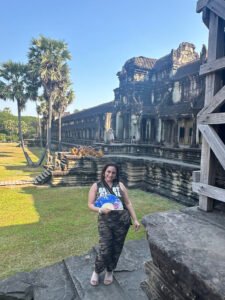
Our destination was the Angkor Wat temple complex, a UNESCO World Heritage Site made up of a series of temples that covers 400 square kilometres. The tour driver took me to the ticket office, where I received a ticket (inclusive of the tour) and some compliments! They seemed to like my style around Siem Reap (the nearest city). My first impression was a bit hazy, partly due to the heat and partly because it was so huge and so different to anything I’d ever seen before. There were a lot of tourists from all over the world, and it was quite crowded, but still less than other places, especially Vietnam.
I was surprised to learn that the temple is the largest religious monument in the world. It’s an interesting contrast to Karbala, Iraq, which hosts the largest annual religious gathering in the world, with 25 million people, and India, which hosts the largest religious gathering in the world during the Kumbh Mela Hindu festival, with 400 million people. But Angkor Wat is the largest religious building. Other major temples in the Angkor complex that I visited were Bayon and Ta Prohm.
What’s made Cambodia, and this particular site, famous in recent years is it’s appearance in the Tomb Raider film series by Angelina Jolie’s Lara Croft. The filming location of the movie, combined with her advocating for Cambodian refugees and displaced persons, has massively boosted tourism to Angkor Wat and Siem Reap.
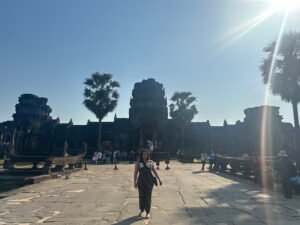
Angkor Wat: Backdrop to a Hollywood Blockbuster
Built in the early 12th century by Khmer King Suryavarman II, it was originally constructed as a Hindu temple dedicated to Vishnu. It later became a Buddhist temple when the state religion changed from Hinduism to Buddhism. The style resembles Gothic architecture, but it’s actually classical Khmer, with typical grand, intricate bas-reliefs, and symmetry. The central tower symbolizes Mount Meru, the home of the gods in Hindu and Buddhist cosmology, and the Bas-reliefs depict mythological stories, historical events, and everyday life.
The religious identity of the place was very confusing for me. First of all, I had no idea there was Hinduism in Cambodia. Secondly, the Cambodians call Vishnu “the other Buddha,” so I didn’t realize it was him till later. Although the temple was originally dedicated to Vishnu and then became Buddhist, pilgrims and visitors still pray to him. Being Muslim, I was still invited to pray to whomever I wanted at the statue, which I thought was nice (this is not the same experience we had in Kandy, Sri Lanka, where a Hindu temple refused to let us in because we were Muslim). Dotted around the site, rather bizarelly, there were several phallic statues devoted to the lingam, or male sexual organ. I didn’t quite know what to do or who to pray for there!
THE SANGHA COMMUNITY OF ANGKOR WAT
In Cambodia and other majority Buddhist countries, monks are revered as the spiritual custodians of Buddhism. Every Cambodian male is expected to ordain as a monk at some point as a credit to himself and his family. Some serve as little as fifteen days; others commit for life. This tradition forges a close bond between the sangha and the laity: monks and nuns depend on laypeople for material support, while lay followers rely on the sangha’s spiritual guidance. By offering food and necessities, lay adherents sow karmic seeds, confident that the sangha provides the richest soil for them to grow.
The sangha (monastic community) took care of the site up from the decline of the Kingdoms until 1907, when archaeologists and conservationists assumed ‘ownership.’ The monk’s continuous presence kept the complex from being reclaimed by the jungle, unlike other religious temples.
From 1975 to 1991, Cambodia endured the spiritual and cultural genocide of the Khmer Rouge. Under Pol Pot, many monks were killed, imprisoned, or tortured, and up to ninety percent of the country’s wats (temples) were destroyed. Although the ancient monuments of Angkor were spared, the local population—including its monks—was forced to evacuate, and modern temples and statues on the site were demolished. The rupture of the monastic community and the loss of its spiritual leaders dealt the sangha a devastating blow from which it is still recovering.
For many locals and monks alike, living or worshipping at the Angkor Wat monasteries remains their only personal way to reconnect with and safeguard this sacred space.
The Smiling Faces of Bayon Temple
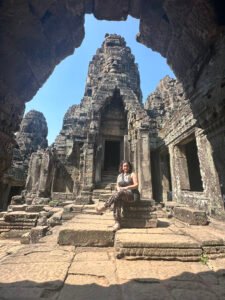
This temple was a bit more cheerful due to the many smiling faces, symbolizing compassion and serenity, but the dark gothic backdrop was still very imposing. Its purpose was to serve as the state temple and the capital of Angkor Thom’s (the Great City’s) religious center. Bayon shows the transition from Hindu to Buddhist influence in Khmer culture.
The most iconic feature is the wonderful and characterful large stone faces carved into the towers, believed to represent Buddha or perhaps the king. The intricate bas-reliefs in the terraces and galleries depict historical events, battles, and everyday life in the Khmer Empire. They also depict Buddhist teachings, scenes, stories of the Buddha’s previous lives, and spiritual symbolism. I really loved those scenes – they gave the place a majestic and other-worldly charm. You could tell whoever commissioned these reliefs wanted posterity to know all about them, their beliefs, their way of life, and their great achievements, all in magnificent style.
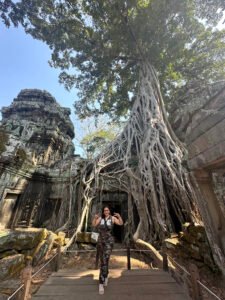
The Epic Jungle Temple: Ta Prohm
However, by far my favourite temple of them all is Ta Prohm. I was absolutely blown away by the epic takeover of the originally Buddhist monastery by parasitic strangler fig trees and their roots. The temple is famous for the giant foliage that has grown over and through the ruins, creating a haunting, nature-meets-ruins vibe. It was astonishingly beautiful and deeply moving.
Strangler fig trees in Cambodia, particularly those found at the Angkor temple complex, are known for their dramatic, vine-like roots that envelop and sometimes engulf ancient structures like Ta Prohm and another temple known as Ta Som. These trees, scientifically known as Ficus religiosa or Ficus aurea, begin life as seeds deposited in the crevices of other trees (or walls), then send down roots that eventually wrap around and take over their host. While they can eventually kill their host tree by blocking sunlight, they also play a vital role in the ecosystem, providing food for animals and helping to stabilize structures in some cases. At Angkor, the strangler figs have become iconic, with their roots dramatically growing over and around the temple ruins, creating a unique and visually stunning landscape. In Cambodian culture, the fig tree is often seen as sacred and symbolic, with some believing it to be a protector.
Built in late 12th to early 13th century, it was originally a university and Buddhist monastery. Being a centre of learning, once upon a time, as well as a spiritual institution definitely added to its charm. Its architectural style is Khmer, but today, the walls, corridors, and courtyards of the buildings where Buddhist monks once lived and worshipped, are crumbling and being reclaimed by nature.
Ta Prohm is often called the “Jungle Temple.” Its wild, overgrown appearance really emphasizes the changing state of the world, impermanence of everything, not just civilization and the power of nature to reclaim what we produce. The other example of that is the town of Chernobyl, where despite nuclear fallout and being abandoned for decades, nature has also reclaimed the site.
The Angkorian state, which thrived from the 9th to the 15th century, was the most significant premodern empire in Southeast Asia, and Angkor Wat, located within the World Heritage site of Angkor, stands as one of its largest religious structures.
Even as the kings, demographics and religions of the complex changed over time, Angkor Wat remained a vital collection of temples and was never deserted. The inscriptions and alterations on each temple bear witness to its enduring history and significance.