On my way back from spending a night in the Sahara, I decided to visit the village of El Jem. I heard there were some interesting Roman remains there. I’m not the type of traveller who researches a lot before going somewhere, so I allow myself to be surprised when I get there.
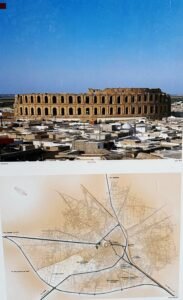
As I got closer and closer to the centre, while driving through the village, I started to see glimpses of El Jem’s epic ruins in the distance. But nothing could have prepared me for the strikingness of the Colosseum, especially towards sunset, and the stark contrast of this cute modern Tunisian village against the magnificent remains of a remarkably well-preserved Roman amphitheatre – one of the largest in the world and a UNESCO World Heritage Site. You would think the crude modern structures might make it a little less spectacular, but it only added to the charm.
The El Jem Amphitheatre, known as the Colosseum of Africa, dates back to the 3rd century AD. Built entirely of stone blocks without foundations, it stands on flat ground unlike many other amphitheatres that are built into hillsides. It sits on a circular piazza surrounded by quaint shops and cafes.
Its design is similar to the Colosseum in Rome, featuring multiple tiers of seating. Its facade features three levels of Corinthian or composite style arcades relying on a complex system of arches to support its massive structure. The interior retains much of its original infrastructure, including the podium wall, arena, and underground passages.
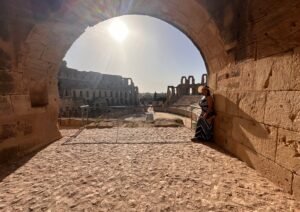
The tunnels
The tunnels beneath the Amphitheatre of El Jem were used as an underground service area that supported the spectacles held in the arena above. They were the “backstage” of the amphitheatre.
Gladiators waited in the underground chambers before entering the arena. They would have prepared themselves there, knowing they were about to fight in front of around 35,000 spectators, making it one of the largest Roman amphitheatres in the world.. Lions, leopards, bears, and other animals used in hunts were kept in cages beneath the arena until it was time for them to dramatically appear onto the arena through trapdoors.
Prisoners condemned to death could also be kept below the arena before being brought up for public executions or other spectacles.
The fact that this sophisticated and complex construction existed in a far-off province, designed purely for entertainment, is a subtle nod to Imperial Roman propaganda and reach.
The amphitheatre would have played a central role in the social and cultural life of the ancient affluent small city of Thysdrus (El Jem today), made wealthy due to its expanse of olive groves and strategic trade location. At the time, it would have been a massive Roman flex, if you will, showcasing the grandeur of Roman architecture and engineering.
Inevitably, after the fall of the Western Roman Empire, the El Jem amphitheater fell into disrepair. But whatever has remained is still hauntingly beautiful to behold. There are many gems of ancient Roman architecture in North Africa – I would love to see Leptis Magna in Libya; however, El Jem remains the gem of colosseums in Africa.