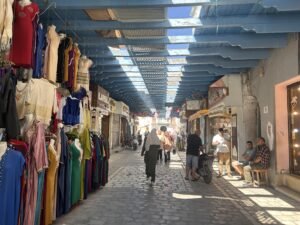
As I entered the gates of the old city, which is surrounded by a high wall typical of historic Islamic cities, I was immediately charmed by the colours and textures of the buildings and street bazaar, its whitewashed streets, traditional houses, and religious monuments. Unlike many famous cities that changed repeatedly through industrialization, Kairouan’s historic centre still conveys the atmosphere of a medieval Islamic city. Walking through its medina, you encounter narrow streets, courtyards, markets, and monuments that reflect over 1,300 years of history. Known for traditional crafts, including carpets and embroidered textiles. A UNESCO World Heritage Site.
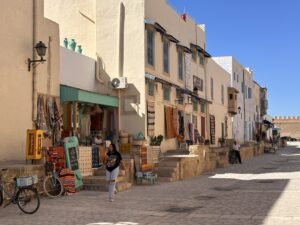
The marketplace opposite The Great Moosque of Kairouan
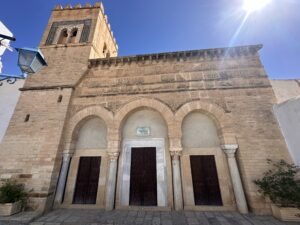
Founded in the 7th century by the Arab general Uqba ibn Nafi during the early Islamic expansion into North Africa. The name Kairouan is thought to derive from the Persian word kārwān (caravan or military camp). It is one of the oldest cities in North Africa.
What began as a military encampment quickly evolved into the capital of the Islamic province of Ifriqiya (roughly modern-day Tunisia and parts of Algeria and Libya). It became a center of Islamic scholarship, architecture, a military headquarters, a trade hub, and political power, and played a major role in shaping the history of the Maghreb.
Between the 9th and 11th centuries, Kairouan rivaled cities such as Baghdad and Córdoba as a center of learning. It became an important center for religious learning, attracting scholars from across the region. The city’s influence spread throughout the western Islamic world.
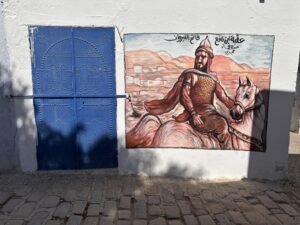
Uqba ibn Nafi wall art
The Carpet museum
Walking along the beautiful white-washed back alleys with pops of stunning graffiti, a man appeared and was enthusiastically trying to lead me to a carpet shop. It was obviously a tout and the destination was obviously a tourist trap, but I was walking in that direction anyway, and I was curious. That’s when I saw this man.
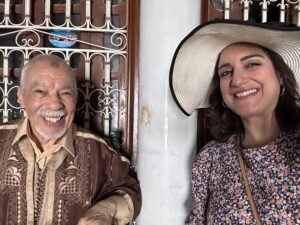
At the carpet museum with the owner
Bir Barouta
I saw a bustle of activity from what looked like both local and international tourists, who disappeared into a staircase through a stone doorway. This turned out to be Bir Barouta, a famous site hidden inside the walls of the old city. Inside I was surprised to find a domed room, a café, lots of people, a tree, a well, and a camel!!
Legend has it that Bir Barouta is mystically connected underground to the Zamzam Well in Mecca. There is no historical or scientific evidence for this; it is a popular religious legend reflecting the deep reverence people had for the site. Another famous legend similar to many traditions around the world is that Anyone who drinks from Bir Barouta will one day return to Kairouan. And yes, I did have a drink! And a walk around the well with the camel.
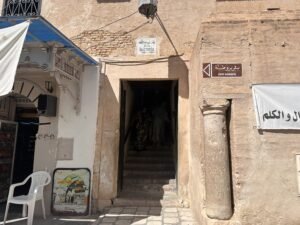
Entrance to Bir Barouta
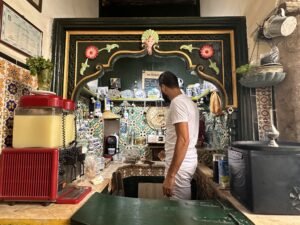
Cafe inside Bir Barouta
One of Bir Barouta’s most distinctive features is its camel-powered noria. A camel walks continuously in a circle, turning gears that raise water from the well. The water then flows to a marble fountain, and a public drinking trough. Back in Kairouan’s heyday, it supplied water to the surrounding arid area.
Unlike many cities that developed beside rivers, Kairouan has no major river.
To supply water, the city relied on collecting rainwater in enormous reservoirs such as the Aghlabid Basins, shallow groundwater, wells, and norias (waterwheels). This technology was widespread across the Islamic world.
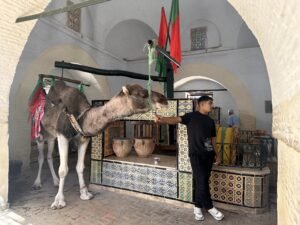
But Bir Barouta is more than just a well. It represents the sophisticated hydraulic engineering that allowed Kairouan—founded in an inland, semi-arid location—to thrive for centuries.
The Aghlabid Golden Age (9th century)
Kairouan reached its greatest prosperity under the Aghlabid dynasty who were somewhat like semi-independent viceroys, ruling Ifriqiya on behalf of the Abbasid Caliphate. They acknowledged the Abbasid caliph’s religious and political authority and they governed their territory with a high degree of autonomy and independence. The Aghlabids managed to develop Ifriqiya into one of the wealthiest and most cultured regions of the western Islamic world. Scholars came from across North Africa and beyond and trade flourished.
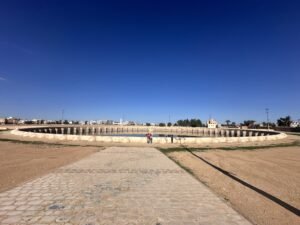
One of the city’s greatest engineering achievements was the construction of the Aghlabid Basins, enormous reservoirs that stored water for the growing population. The combination of the Aghlabid Basins (for large-scale rainwater storage), wells like Bir Barouta, camel-powered waterwheels, and carefully managed irrigation made it possible for Kairouan to become one of the great cities of the medieval Islamic world despite its limited natural water resources.
The Great Mosque
At the heart of the city is the Great Mosque of Kairouan, one of the oldest and most influential mosques in the Islamic world. Renowned for its massive square minaret and ancient columns, many reused from Roman buildings, it influenced later mosque architecture throughout North Africa and Al Andalus (Islamic Spain).
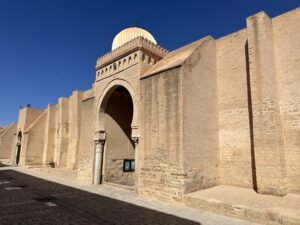
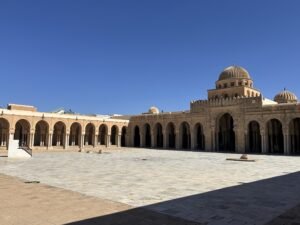
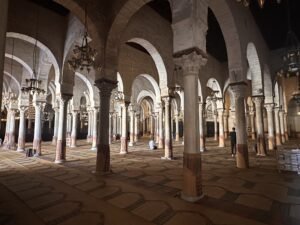
As I left the old city, I walked along the outer wall back to my car and an interesting wall plaque caught my eye. It reads in hand-engraved diwani, thuluth and ruq’ah script:
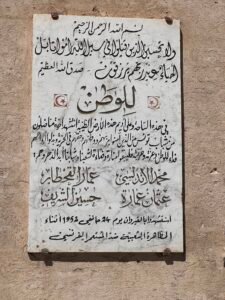
| In the name of God, the Most Gracious, the Most Merciful “And do not think of those who have been killed in the cause of Allah as dead. Rather, they are alive with their Lord, receiving provision.” — Qur’an 3:169 For the Homeland In this square, upon this blessed ground, fell as martyrs a group of patriotic brothers from the youth of Tunisia, who believed in their Lord, in their homeland, and in their right to freedom. They sacrificed their lives for the sake of their country and its dignity. May they forever remain a beacon for our people and our youth. They are:
They were martyred in Kairouan on 24 January 1952 during the popular demonstration against the French colonial occupier | بسم الله الرحمن الرحيم ولا تحسبن الذين قتلوا في سبيل الله أمواتاً بل أحياءٌ عند ربهم يرزقون – صدق الله العظيم.
للوطن
في هذه الساحة وعلى أريم هذه الأرض الطيبة استشهد اخوة مناضلون من شباب تونس الذين آمنوا بربهم ووطنهم وحقهم في الحرية وبذلوا أرواحهم فداء للوطن وعزته فليبقوا منارة و… لشعبنا وشبابنا أبد الدهر وهم:
محمد الأندلسي. عمار القحطار عثمان عمارة. حسين الشريف
استشهدوا بالقيروان يوم ٢٤ جانفي ١٩٥٢ أثناء المظاهرة الشعبية ضد المستعمر الفرنسي
|
This plaque commemorates one of the pivotal moments in Tunisia’s struggle for independence. On 24 January 1952, demonstrations broke out across Tunisia after France rejected Tunisian demands for greater self-government and arrested nationalist leaders. In Kairouan, protesters marched against French colonial rule. French forces opened fire, killing several demonstrators, including the four men named on this memorial.
These events became symbols of the Tunisian independence movement, which ultimately achieved independence on 20 March 1956. As the original spark of the 2011 Arab Spring, the gentle nature of Tunisians hides beneath it a fierce love and sense of duty to their land. This plaque is a memorial to that spirit.